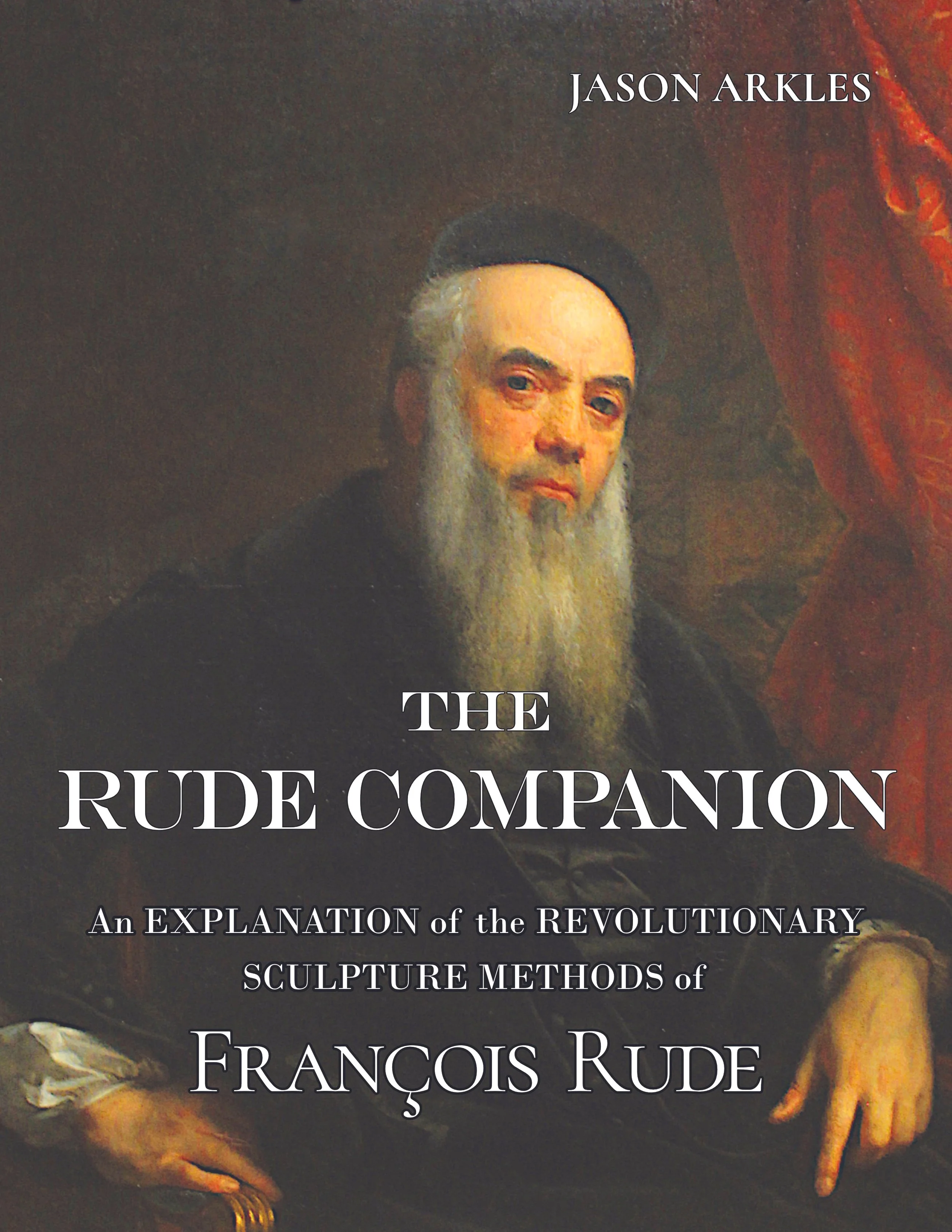
The Rude Companion
An Explantion of the Revolutionary Sculpture Methods of François Rude
"I have no words for praise, nor a pretext for criticism. It's not just bones, muscles and flesh, it's skin; it is an elastic and uneven tissue, thick under the feet, taut on the bones, soft on the stomach, shiny on the face, thin and transparent on the lips; it is water in the eyes, air in the hair. The head speaks; he honestly laughs. Statuary has never been better able to approach vivacity without artifice and without exaggeration."
Such was the reception of Neapolitan Fisherboy Playing with a Tortoise at the Paris Salon of 1833; its creator, François Rude, was hailed as a transformative force in sculpture. He was among the first to break from Neoclassical sculptural aesthetic which had held sway in France for fifty years, and his achievements were made possible, in part, through his groundbreaking methods of modeling figures in clay from the living model. Developing his methods during his exile in Belgium, Rude’s intention was to find an approach to the human figure that was--in his words--more honest than simply making figures ‘look Greek’.
Rude’s teaching was as influential as his sculpture. The master of Jean-Baptiste Carpeaux, Emmanuel Frémiet, Charles Cordier, Ernest Christophe and dozens of others, he catalyzed the sculpture of the Romantic period and beyond by disseminating techniques that were not derived from the aesthetics of Antique sculpture, canons of proportion or other invented styles, but from fidelity to nature—specifically, fidelity to the visual appearance of nature.
And what was Rude’s original technique, exactly? Where can an explanation of this method be found?
Rude: Sa Vie, Ses Œuvres, Son Enseignement by Maximin Legrand, published the year after François Rude’s death, purports to give a step-by-step explanation of the technique Rude developed. Yet this obscure book has never been published in English, nor reprinted in French. How strange that this book remains unknown to sculptors!
Rude’s later biographers have unintentionally mis-characterized this method, thinking it to be merely a measuring technique, but it was in fact much more. The key to the method is not in meticulous measurement, but in meticulous observation. Rude’s method employs a visual geometry requiring exacting spatial relations between model, clay, and the sculptor, a sculptural process unique in Rude’s day. The consequence of these spatial relations is a process driven by the eyes and mind of each practitioner, producing ‘naturalistic’ sculpture, faithful to the observed experience of its author. Its results vary according to whoever practices it, unleashing the perception and will of each individual from any prescriptive or predetermined style.
The Rude Companion presents for the first time an English translation of Rude’s method as recorded by Maximin Legrand, with notes and images giving context and clarity, as well as an exploration of what Legrand may have omitted in his record of the method.
To further understand the theory and aesthetics underpinning Rude’s method, The Rude Companion includes:
Recherches sur l’art Statuaire, by Toussaint-Bernard Émeric-David (abridged), the influential essay which provided Rude with aesthetic and procedural direction: “We must not confine ourselves to copy the Greeks; we should educate ourselves in the same studies; we must follow the road they had traveled… Do not think you can put style into your work at the expense of truth.”
A discussion of the progressive educator Joseph Jacotot, originator of the Theory of Universal Education, who inspired Rude with his panecastic philosophy of experimentation and development.
Appendices of related technical processes mentioned in Legrand’s instruction, including compass pointing for marble sculpture, and clay model enlarging and reducing.